
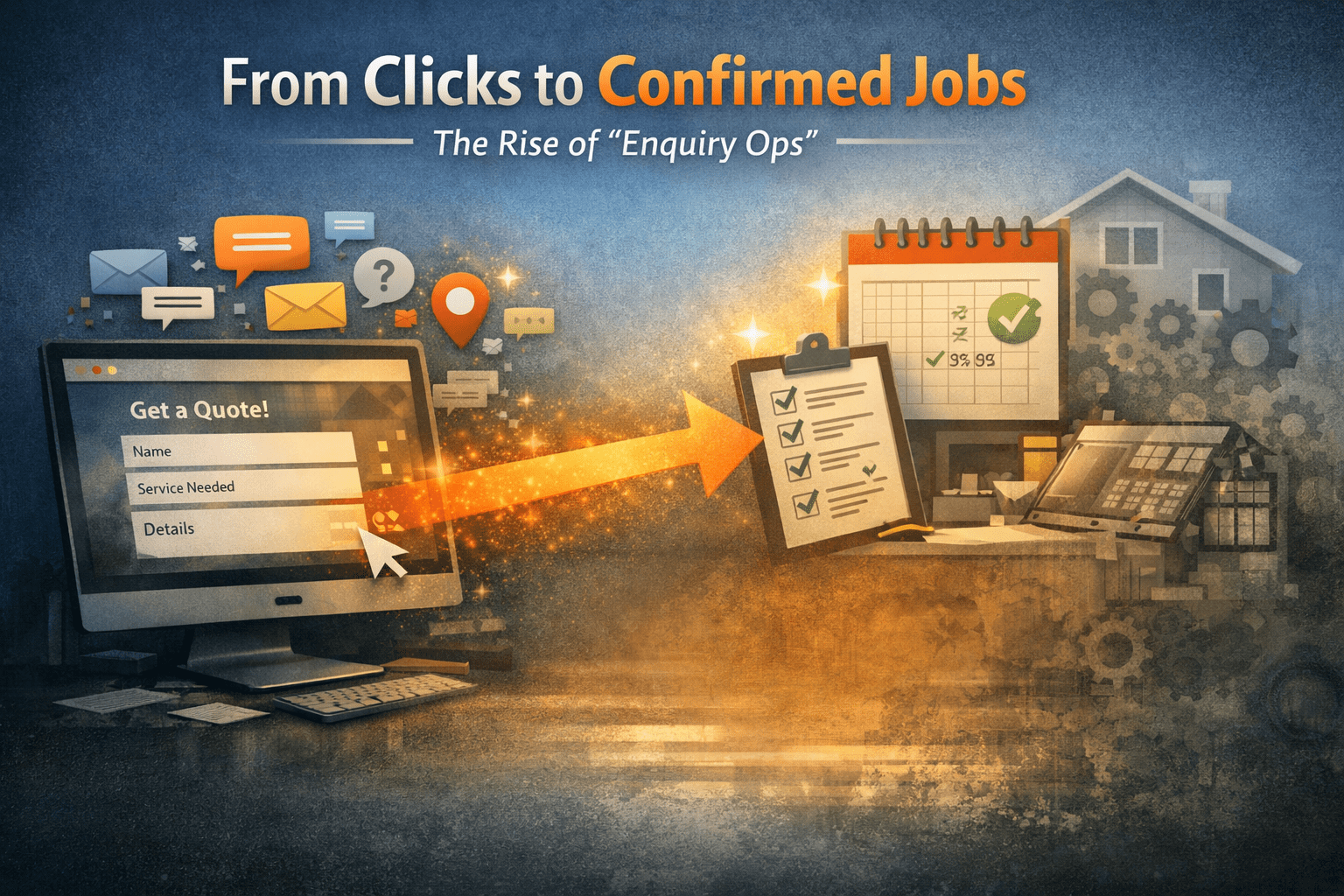
If you work with local service businesses long enough — plumbers, electricians, roofers, cleaners — you see the same pattern everywhere: the website gets traffic, but the enquiries are messy. People ask vague questions, ignore important details (postcode, access, urgency), and the business ends up doing unpaid admin just to find out whether the job is even real.
That’s the gap ATO exists to close.
On the surface, the ATO website positions this as a conversion problem — “turn your website into a quote-request machine.” It’s a clear promise, and it’s grounded in something real: smarter forms, a clearer “Get a quote” journey, and fewer time-wasting enquiries (https://alltimedout.com/). But under the hood, the direction is bigger: ATO is evolving into a Growth Engine that treats enquiries like an operational pipeline — not just “leads,” but inputs that need qualification, routing, compliance and follow-up.
Why this matters more in 2026 than it did a year ago
Two big shifts are pushing businesses toward better systems:
1) Inbox rules are tightening — and lazy outreach is dying.
Deliverability now lives or dies on fundamentals: SPF, DKIM, DMARC, list hygiene, and engagement signals. Dotdigital’s recent deliverability guidance is blunt about authentication being non-negotiable (https://dotdigital.com/blog/the-not-so-basic-basics-email-deliverability/), and Salesforce frames authentication as central to sender reputation (https://www.salesforce.com/uk/marketing/email/deliverability/). Even checklist-style guides are now treating things like unsubscribe requirements and monitoring as table stakes (https://www.egenconsulting.com/blog/email-deliverability-2026.html).
If you’re building an outreach engine (which ATO is), you can’t bolt “compliance” on at the end. It has to be baked into the workflow — how you capture data, how you segment, how you send, and how you handle opt-outs.
2) Search is getting harsher on low-value content — and that affects lead quality.
Google’s March 2026 spam update chatter is another reminder: thin, manipulative, or mass-generated content is increasingly risky, and strong signals of trust and usefulness matter more than ever (https://www.damteq.co.uk/resources/articles/googles-march-2026-spam-update-explained/). You can even see this filtering down into local marketing conversations on social media — for example, businesses posting about Google’s spam update and how it changes what “good” looks like (https://www.instagram.com/p/DWab_PtjBDE/).
The practical takeaway for local services is simple: more traffic isn’t the win if the funnel leaks. Better intent capture beats bigger reach.
The rise of “agentic” workflows — and why ATO is leaning that way
There’s a broader trend happening in business IT right now: moving from AI that writes things to AI that does things. Microsoft’s recent Copilot updates and agent-like workflow direction are part of that arc (https://www.reuters.com/business/microsoft-unveils-ai-upgrades-rolls-out-copilot-cowork-early-access-customers-2026-03-30/), and Microsoft itself is pushing “digital labour” as an SMB productivity theme (https://www.microsoft.com/en-gb/microsoft-365-copilot/business).
In plain English: businesses want systems that don’t just generate copy — they want systems that capture intent, classify it, trigger the next step, and keep everything organised.
That’s exactly where ATO’s Growth Engine is heading. Recent development work has focused on turning ATO from a single-environment tool into a multi-user, workspace-based application with authenticated access — the kind of foundation you need if this is going to become a real product, not a personal spreadsheet with a UI. From there, the priorities are very “enquiry ops”: lead review flows, evidence/status tracking, and an email/editor layer so outreach can be consistent, compliant, and scalable.
And this lines up with what the market is already discussing: “agentic AI” and automated lead qualification workflows are increasingly presented as the fastest path to immediate relief for small teams (https://www.forbes.com/sites/terdawn-deboe/2026/03/27/10-ai-agents-for-small-business-that-give-immediate-relief/).
The ATO bet: better questions beat better persuasion
A lot of marketing advice is still obsessed with persuasion — headlines, hooks, clever copy. That matters, sure. But for local service businesses, the real money is in asking better questions at the right moment.
A good enquiry funnel doesn’t just “convert.” It filters. It protects time. It turns a vague request into a job-ready brief. And when you combine that with the Growth Engine’s direction — automation, tracking, compliant outreach, and structured routing — you end up with a system that can genuinely change how a small business operates day-to-day.
That’s what we’re building: not just more leads — cleaner, more actionable enquiries, and a workflow that makes them easier to turn into booked work.
 All Timed Out